Creating a Full-Funnel Email Marketing Strategy That Converts
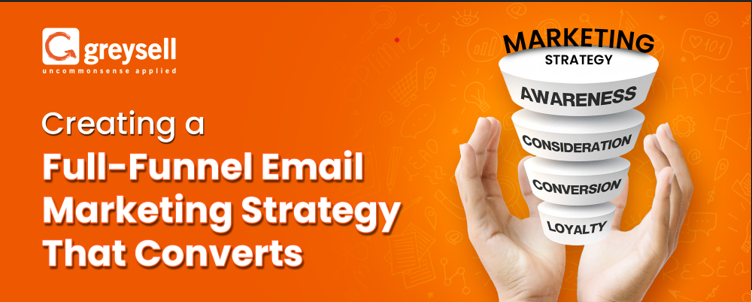
Creating a Full-Funnel Email Marketing Strategy That Converts
Have you noticed most product launches fail after a certain period? This happens because these products do not stay at the top of the minds of consumers.
You’ve built something valuable with an effective landing page, the right message targeted to the right target audience, yet you are not able to convert.
That’s where Greysell, a leading digital marketing agency in Mumbai, makes brands shine with the power of an email marketing campaign strategy. We provide a full-funnel strategy guiding subscribers from awareness to action. Let’s discuss and show how you can launch smarter, using emails at every stage of the customer journey.
Why You Need a Funnel-Based Email Strategy
Before getting deep into tactics and strategies for emailers with conversions, let’s understand the basics. A single email won’t drive conversions. You need to slowly and steadily nurture the mails that push the consumers deep into the buying funnel. From directing consumers from awareness to the conversion funnel.
Here comes the TOFU-MOFU-BOFU model:
TOFU (Top of Funnel): Build awareness and curiosity
MOFU (Middle of Funnel): Drive consideration and engagement
BOFU (Bottom of Funnel): Push conversions with offers and urgency
Each stage serves a unique purpose.
These stages are uniquely structured in the email automation process for product launch.
You don’t just sell. You educate, inspire, and engage. Especially during a launch, where trust and clarity are everything.
So at the TOFU stage, you introduce your brand and the product. Give details about the product, how it will solve the pain point of consumers. With a series of mailer communications, the audience will get clarity about the product/service, and they will go to the next stage of consideration (MOFU).
In MOFU, they will add you to the consideration stage. More in-depth information and knowledge need to be dispersed to give consumers the confidence to buy your product/service.
In BOFU, give exclusive offers to customers to make the final purchase decision.
Each phase requires different messaging to guide subscribers closer to making a purchase.
Why is this critical? Because 80% of customers don’t buy until after 4–5 brand interactions. If your product launch strategy only includes one or two emails, you’re leaving money on the table.
Breaking Down the Funnel
Top of Funnel (Awareness)
The goal of the TOFU email marketing strategy is to grab attention and start the conversation.
At this stage, your subscribers might not know they need your product.
Your job is to intrigue, create curiosity and educate them—without being pushy.
Email types:
“Coming Soon” teasers
Brand storytelling that tells about the brand and how it's committed to solving the problem.
Problem-led narratives about how the brand recognised the problem and has devised a solution
Example:
“Something game-changing is coming your way…”
Build excitement, build suspense—and keep it short and curiosity-driven.
Middle of Funnel (Consideration)
The goal of the MOFU email marketing strategy is to nurture interest and show relevance. Once your audience is aware, they need a reason to care. Use emails here to showcase your product’s value, differentiation, and real-world applications.
Email types:
Many email types are being made as per the requirement of action from the target audience:
Product benefits and features: This explains the products and features to create awareness and be in the consideration set.
Use-case breakdowns: Case studies give confidence to the audience about what kind of clients we have worked with.
Social proof and early testimonials: This gives the audience proof of how the work has impacted and the results achieved by clients.
Example:
Discover how [Product] saves [X hours] a week for [Target Users].”
At MOFU, your subscribers are evaluating. Help them feel confident.
Bottom of Funnel (Conversion)
The goal of the BOFU email marketing strategy is to drive immediate action.
This is launch time. Focus on urgency, limited-time offers, and clear CTAs. Make it easy for the customer to act.
Email types:
Official launch announcement: Announcing the arrival of the product/ service.
Discounts or early-bird offers - Persuasive emails to try or sample the product/service.
Countdown and reminders: Create urgency and generate FOMO to take action
Example:
“It’s here! 20% off for the next 48 hours only.”
A compelling offer and a ticking clock can skyrocket conversions.
How to launch a product during the marketing sample sequence
Here’s a simple yet powerful email flow that aligns with the funnel stages:
Teaser / Coming Soon
The awareness stage should start with a teaser/ coming soon message.
For example, the subject line and purpose could be stated as given below:
Subject: “We’re about to change the game…”
Purpose: Spark curiosity and hint at what’s coming.
Product Benefits
From the awareness stage, you should move to the consideration stage by giving more information about products and services.
For example, the subject line and purpose could be stated as given below:
Subject: “Why [Product] is the upgrade you’ve been waiting for”
Purpose: Showcase value and relevant features.
Testimonials or Beta Feedback
At an element of trust to your audience with customer testimonials in email content.
For example, the subject line and purpose could be stated as given below:
Subject: “Early users are loving [Product Name]—here’s why”
Purpose: Use social proof to build trust.
Launch with Offer
This is the last buying cycle stage where grab the customer with exciting offers and deals
Subject: “It’s finally here! Get 20% off [Product Name]”
Purpose: Create urgency and drive conversions.
Reminder / Last Call
Subject: “Last chance! 20% off ends tonight”
Purpose: Use FOMO to close the sale.
Each email plays a role. Together, they form a funnel that converts.
Email Best Practices for Higher Conversions
Writing great emails is one thing. Optimising them for performance is another.
Subject Line Tips
Keep it under 50 characters
Use urgency, curiosity, or value
A/B test every time
Examples:
“Launching tomorrow—don’t miss out!”
“The wait is over: [Product] is here”
Personalization
Use names and behavioural data - Make the customer feel special
Reference user preferences or past activity
Mobile-First Design
Over 70% of emails are opened on mobile. Keep it:
Short and scannable
CTA above the fold
Use big buttons
Strong CTA (Call-to-Action)
Be direct: “Buy Now”, “Claim Your Discount”
Repeat it within the email body (top and bottom)
Email Open Rates
Email open rates are one of the most crucial metrics in evaluating the success of your email marketing campaigns—especially during a product launch. An open rate indicates the percentage of recipients who open your email, serving as the gateway to engagement. While subject lines, sender names, and timing significantly influence opens, personalisation and relevance are equally key. According to industry benchmarks, a healthy open rate typically ranges between 20–30%, but well-segmented and teaser-style pre-launch emails can often exceed that. Remember, if your emails aren’t being opened, your funnel won’t even get the chance to convert.
Converting email subscribers
Converting email subscribers means turning engaged readers into paying customers—and it doesn’t happen by accident. It requires a well-timed combination of value-driven content, trust-building communication, and strategic calls to action. The key is to guide subscribers through a journey: from awareness to consideration and finally, to conversion. Offering exclusive perks, showcasing social proof, and creating urgency through limited-time offers are proven tactics. Additionally, using behaviour-based triggers—like sending a discount to someone who clicked but didn’t purchase—can dramatically increase conversions. Ultimately, consistent value and smart segmentation turn subscribers into loyal customers
Tools to Build Your Funnel
Your funnel is only as strong as the tools that automate it.
Recommended Email Platforms:
Mailchimp – Easy to use, great templates
Zoho Campaigns – Budget-friendly and integrated with CRM
Klaviyo – Best for e-commerce segmentation
Mailmodo – AMP emails for interactive launches
Automation Must-Haves:
Triggered Sequences: Send follow-ups based on opens/clicks.
Segmentation: Tailor emails by geography, behaviour, or user intent.
Drip Campaigns: Gradually warm up leads over days or weeks.
These tools help you scale your product launch without losing personalisation.
Conclusion
Greysell, a leading digital marketing agency in Mumbai, knows that a one-size-fits-all launch email simply doesn’t cut it anymore.
A full-funnel email marketing strategy allows you to build hype, nurture trust, and convert faster—all with precision.
Don’t treat product launch emails as one-time events. Treat them as a journey—one that moves your subscribers from interest to action.
Need help building your product launch funnel? Let’s talk strategy, connect with Greysell

We are an uncommon advertising agency offering 360-degree advertising solutions. Based out of Mumbai, India, we operate in three specialized verticals – Mainline, Digital, and Event Creatives.
Contact Info
All Rights Reserved By Greysell Marketing Promotions Pvt. Ltd.